Managing domains across regions has become a study in local patterns. Enterprise portfolios often span hundreds or thousands of domains, and registration decisions may involve markets, trademarks, fraud exposure, departments, brand owners, and geographies.
Research from our latest Domain Name Trends 2026 report shows that the global baseline still starts with familiar extensions: .com ranks first, with .net, .co.uk, .org, and .info making up the top five respectively. Yet after those global anchors, regional preferences quickly reshape the picture.
Why regional domain strategy matters
The difference between a generic top-level domain (gTLD) and a country code top-level domain (ccTLD) is more than taxonomy. For example, gTLDs such as .com, .net, and .info are unrestricted and open to all, while ccTLDs are tied to countries or regions, such as .uk for the United Kingdom, .mx for Mexico, and .asia for Asia. Across large corporations, both categories appear throughout the rankings, reflecting a portfolio landscape shaped by global recognition, local markets, and fraud exposure.
EMEA: ccTLDs carry strong regional weight
In EMEA, ccTLDs sit close to the top. The most used extension among EMEA companies remains .com, but .co.uk ranks second in the region and third globally, while .fr ranks third in EMEA and seventh globally. The top 10 for the region also includes .de, .eu, .uk, and .nl, showing how European identifiers sit alongside global staples, such as .com, .net, .org, and .info.
The mechanics behind these registrations add another layer. Most European country extensions are available on a first-come, first-served basis, though some have requirements like an address within the European Union. That combination aligns with the region’s stronger ccTLD profile compared with the Americas: The EMEA domain landscape reflects both corporate registration habits and country-specific structures.
North America: gTLD dominance and repurposed extensions
North America looks more concentrated around global gTLDs. The top five regional extensions are .com, .net, .org, .info, and .biz, all gTLDs. After that, the list becomes a mix of ccTLDs from multiple locations, including .co.uk, .us, .ca, .de, .uk, .eu, .co, and .fr.
One standout is .tv, the country code for Tuvalu. In North American corporate registrations, .tv ranks 17th regionally and 13th globally, but its meaning has stretched beyond geography. Because of its association with television, it has been widely adopted by media companies and effectively operates as an industry-themed extension. The same pattern appears elsewhere in the domain landscape, where some country-code domains function like quasi-gTLDs. For example, .co (ccTLD for Colombia) functions as a typo-adjacent alternative to .com, .cc (Cocos Islands) functions as another .com alternative, and .io (Indian Ocean territories) functions as a shorthand for input/output used in tech companies.
APAC: Layered local and second-level patterns
In APAC, domain registrations often include both ccTLDs and restricted second-level domains under those ccTLDs. For example, Hong Kong appears through both .hk and .com.hk TLDs. Singapore appears through .sg and .com.sg. And New Zealand appears through .nz and .co.nz. The rankings mirror that structure: .com.au is the most used TLD in APAC and ranks sixth globally, followed by .com, .au, .co.nz, and .net.
The APAC list also includes .net.au, .com.sg, .sg, .com.hk, .hk, and .com.cn, making second-level structures a visible part of the region’s corporate registration habits. The only generic top-level domain in the APAC top 20 list beyond the long-established global gTLDs is .asia, like .eu in the EMEA rankings.
Where registration patterns meet fraud
The regional pictures connect directly to abuse patterns. In a six-month snapshot of fraudulent websites, .com accounted for 46% of fraud takedowns, followed by .de at 10%, .com.br at 9%, .net at 8%, .xyz at 4%, and other extensions at 23%. Of the top domain extensions used in fraud, 75% were gTLDs. The data also shows a gap between what large corporations register and where fraudulent activity occurs, with extensions such as .icu, .cyou, and .sbs appearing in fraud but not among extensions commonly registered by large corporations.
That gap is becoming more visible around .ai. Since the launch of ChatGPT and the more widespread adoption of AI chatbots and agents, interest in .ai domains has increased among both corporations and bad actors. Among Forbes Global 2000 brand-related .ai registrations, third-party ownership rose from 43% in 2023 to 52% in 2026.
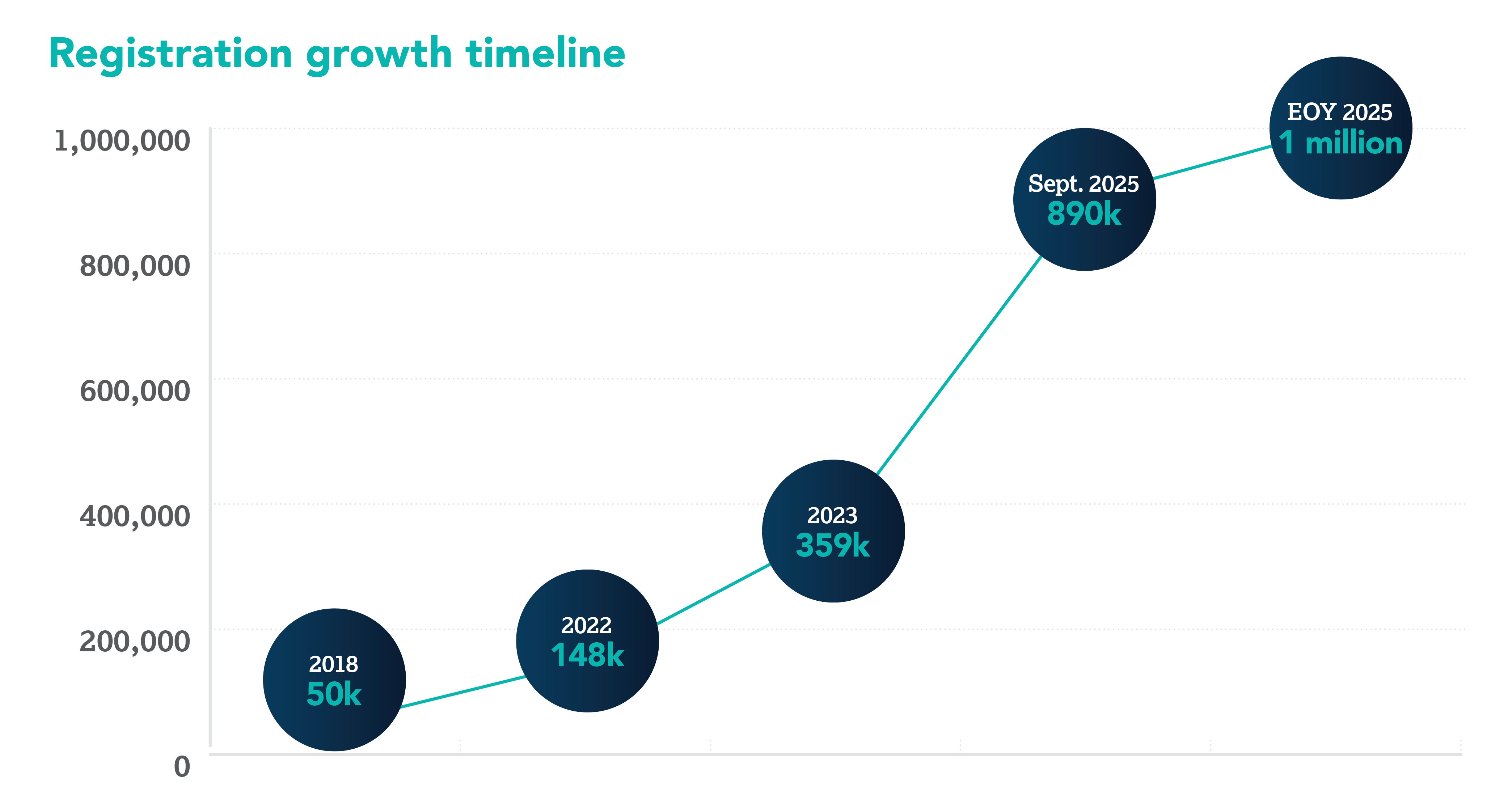
Registration volume climbed from 50,000 in 2018 to 1 million by the end of 2025.
A regional view of a global portfolio
The clearest pattern is that geography changes the domain mix. EMEA uses more ccTLDs, APAC combines ccTLDs with second-level domains, and North America primarily uses gTLDs with ccTLDs and repurposed extensions thereafter. At the same time, the global anchors remain powerful: .com and .net lead the overall rankings, and gTLDs are the most widely used domains in every region.
For more registration data insights, download CSC’s Domain Name Trends 2026 report.