
Every year, the holiday season brings a wave of online shopping—and, unfortunately, a surge in online brand abuse. For the past three years, we’ve monitored infringement patterns across leading online marketplaces, social media platforms, and domain registrations.
There’s a clear trend: seasonal intellectual property (IP) infringements rise sharply in Q4. They stay high through January, when post-holiday sales draw heavy consumer traffic.
Why holidays are a prime time for brand abuse
The combination of high demand, gift-driven impulse buying, and deep discounting creates a perfect environment for cybercriminals. Over the holidays, fraudsters:
- Set up fake websites and lookalike domains impersonating legitimate brands
- Launch social impersonation campaigns, potentially selling counterfeit goods
- Push counterfeit or unauthorized products through marketplaces and social commerce
The result is more than just financial loss for brands. These infringements expose consumers to counterfeit goods, phishing schemes, and fraudulent payment pages that can put their personal information at risk.
We’ve examined infringement activity across hundreds of top enterprise clients. We’ve analyzed quarterly and seasonal activity (defined as Q4, October–December, plus January) to reveal the full holiday impact.
Where IP infringements occur: three main categories
CSC tracks three types of online infringements:
- Marketplace violations—fraudulent listings, counterfeit goods, unauthorized sellers
- Domain infringements—lookalike domains, fake sites, typosquatting
- Social media infringements—impersonation accounts, fake promotions, scam pages
Together, these categories create a broad attack surface that expands every holiday season.
Data highlights: a notable shift in where abuse happens
1. Overall holiday season infringements keep climbing
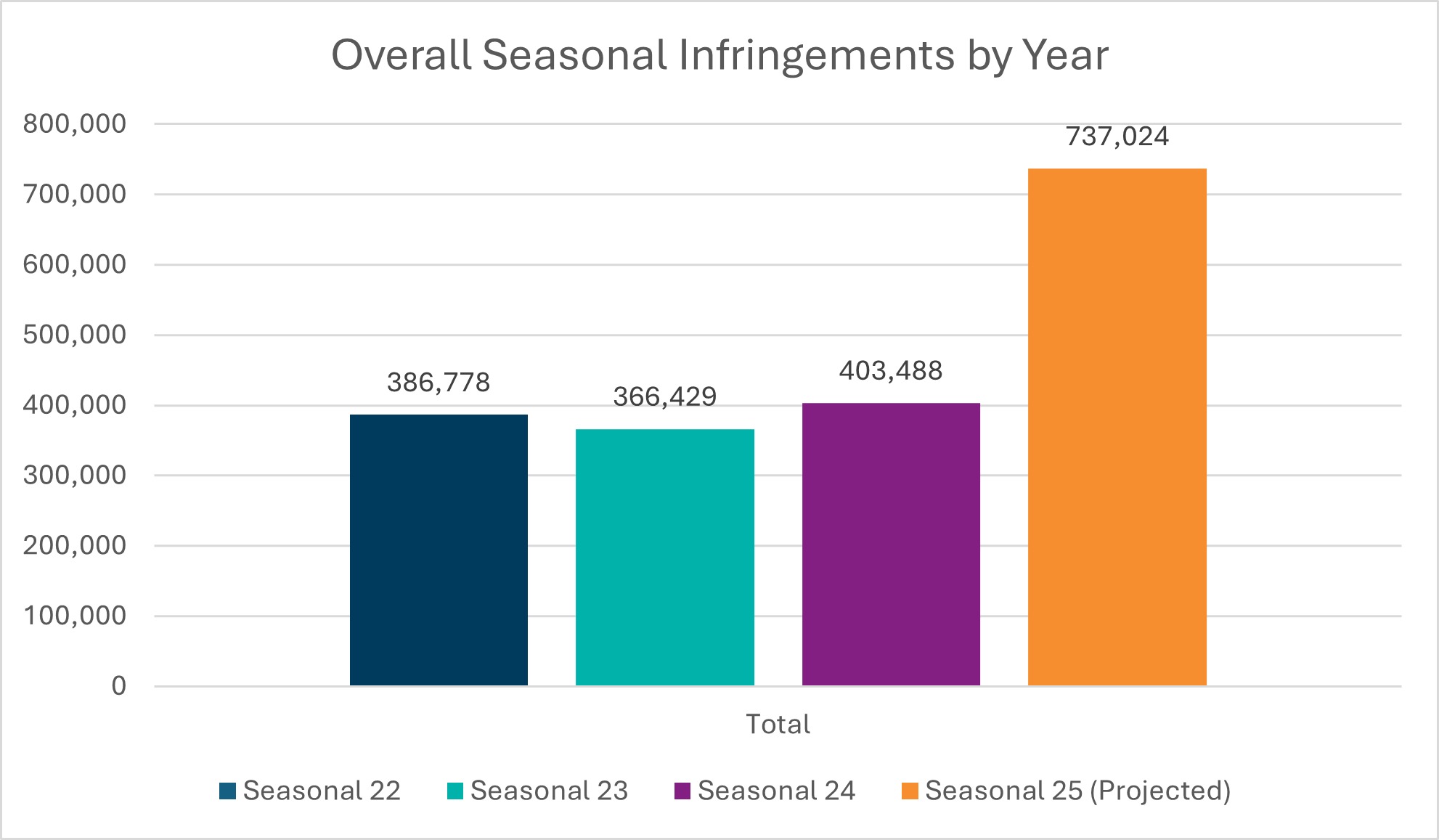
After a dip from 2022 to 2023—likely influenced by post-pandemic economic shifts—CSC’s data shows a renewed upward trajectory. Seasonal infringement totals in the most recent cycle increased significantly year over year, reflecting both rising abuse volumes and the growing sophistication of online scammers.
2. Social media and domain infringements now drive the increase
Historically, marketplace abuse made up the bulk of enforcement actions. But our newest data shows a sharp pivot:
- Marketplace share is declining, representing roughly two-thirds of all enforcement actions in 2023. Projections show a drop to as low as 40% in 2025 if current trends continue.
- Social media infringements are increasing, growing from about 31% of enforcement share in 2023 to a projected 53% in 2025.
- Domain-based infringements are rising, from 2% to 7%. Fraudsters are relying on private sites—often linked through deceptive social posts—to carry out scams.
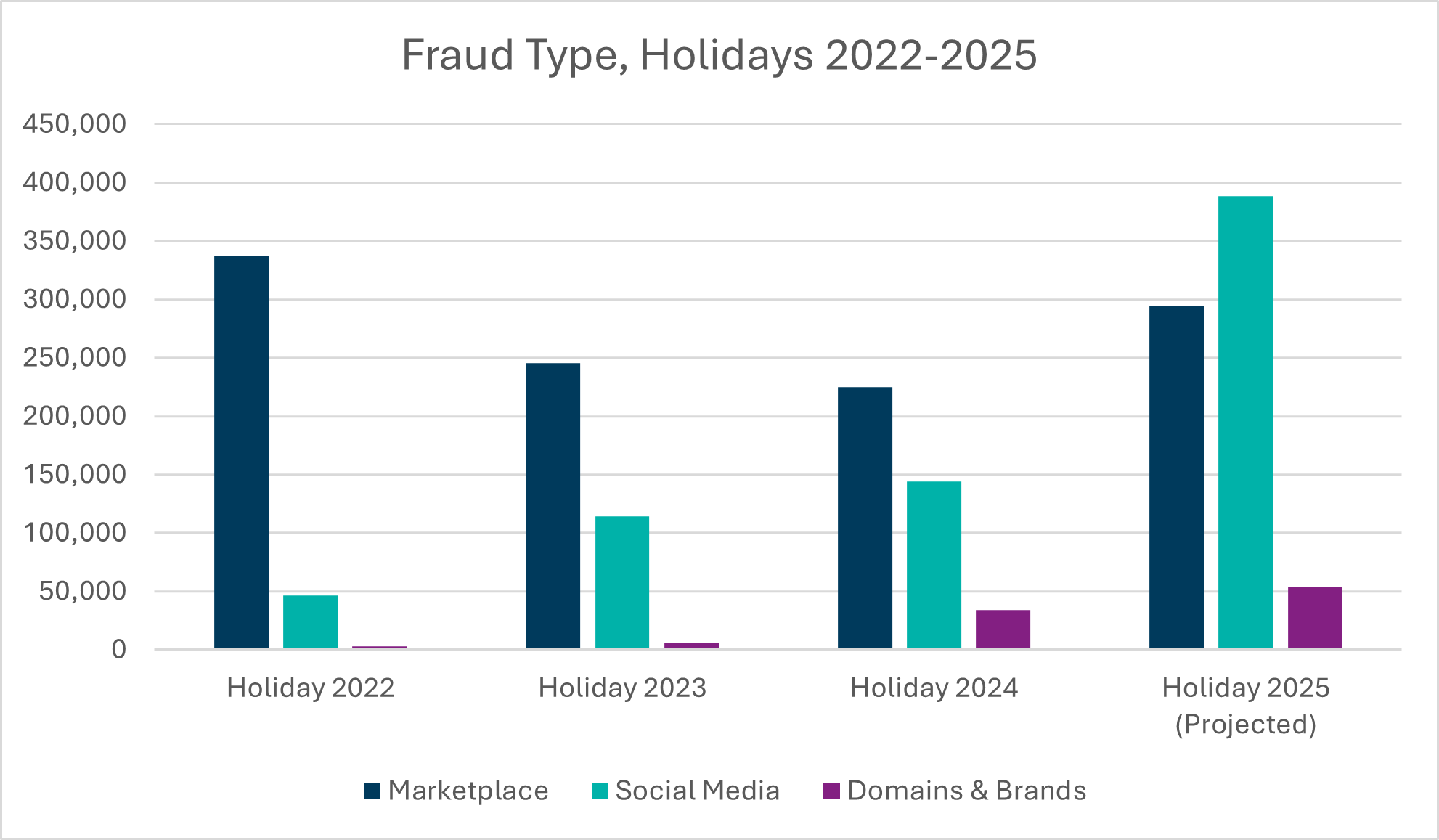
This shift shows counterfeiters and fraudsters are moving beyond traditional marketplaces. They’re adopting tactics that mix social engagement with off-platform sales funnels.
3. Enforcement actions reveal where criminals are focusing their efforts
“Enforcement actions” include our work to remove fraudulent listings, disable impersonation accounts, and neutralize domains that abuse brands. Tracking these actions helps determine where scammers are investing their time.
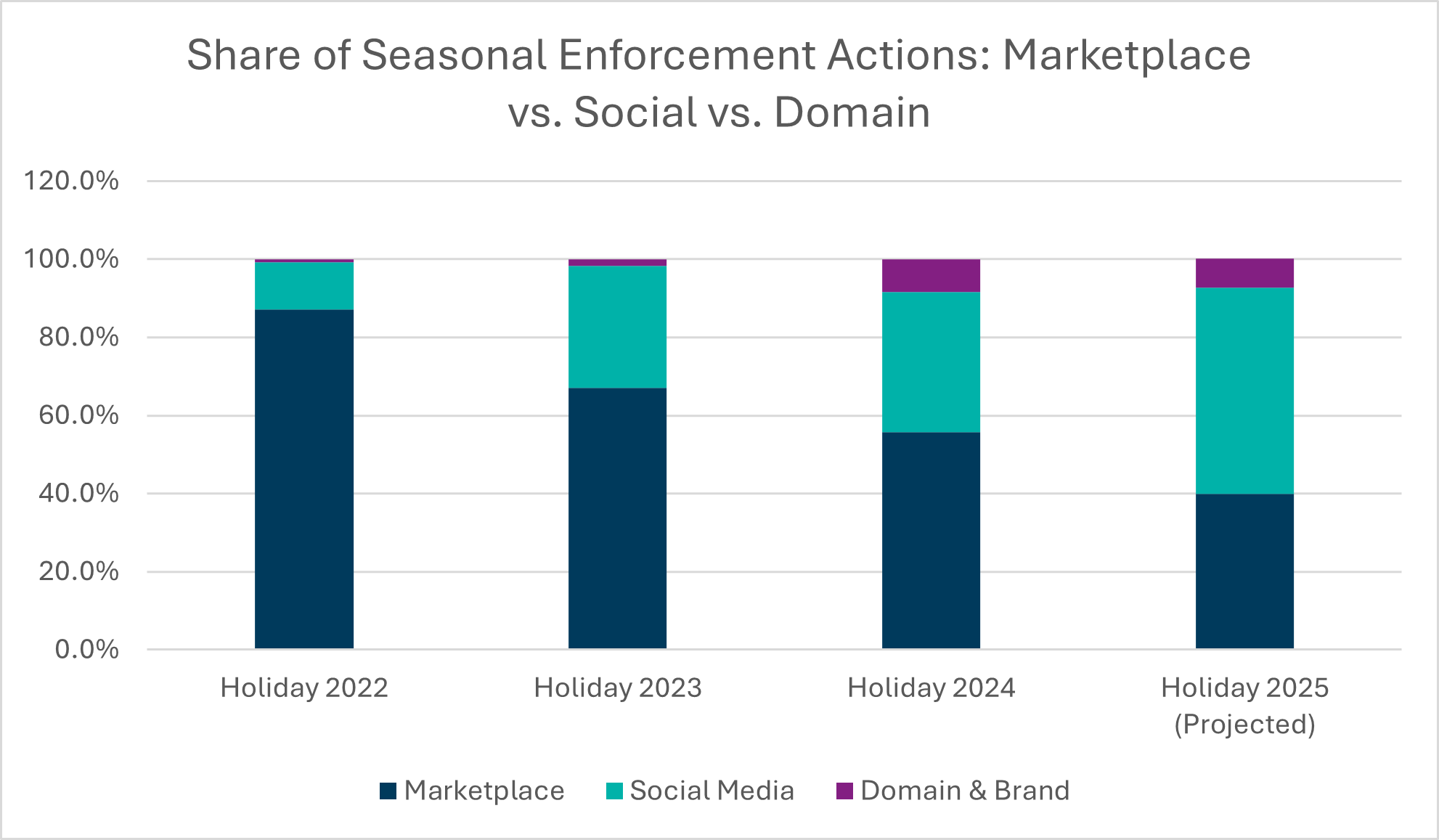
The direction is clear: social and domain actions are rising faster than marketplace actions, which have begun to stabilize for long-standing clients.
Why this shift matters for consumers and brands
For consumers
More scams now start on social platforms, where authenticity cues are often subtle or misleading. A scam post may appear legitimate, use near-identical branding, and link out to a sophisticated fake site designed to harvest personal or financial details.
For enterprises
The rise of social-led and domain-led fraud means enforcement is more complex. Marketplace takedowns follow structured processes, while social and domain abuse need rapid investigation, multi-platform coordination, and specialized monitoring to catch threats before they spread.
How to stay safe during the holiday season
Below is a selection of practical tips to help both enterprises and consumers reduce risk.
1. Stick to trustworthy sellers and websites
- Check seller histories and reviews across multiple platforms.
- Look for “verified” badges and HTTPS-protected websites.
- Avoid listings with vague or inconsistent product descriptions.
2. Protect your payment and financial information
- Never share full card details or PINs via email, chat, or social media.
- Use strong passwords and two-factor authentication on financial accounts.
- Buy gift cards only from reputable, brand-verified sources.
- Monitor bank statements for unexpected transactions.
3. Avoid social media impersonation scams
- Verify follower counts, post history, and cross-platform consistency.
- Ignore unsolicited offers, giveaways, or urgent requests for information.
- Use official customer-service channels, not unverified accounts.
4. Stay alert to links and phishing attempts
- Hover over links before clicking to check the real destination URL.
- Watch for subtle domain misspellings (e.g. “l” vs. “I”).
- Avoid clicking on links in unsolicited texts or direct messages.
- Enterprises should monitor proactively to identify early signs of impersonation or domain abuse.
The bottom line
IP infringement is evolving quickly, and the holiday season amplifies every weak point, whether it’s a vulnerable domain, an impersonated social profile, or a marketplace exploited by rogue sellers. With social and domain abuse accelerating faster than marketplace fraud, enterprises can’t just rely on traditional enforcement strategies.
Is your brand prepared to detect and shut down fast-moving holiday scams across domains, social media, and marketplaces?