Risk leaders are operating in a digital environment where brand protection, cybersecurity, compliance, and customer trust increasingly overlap. A company’s domain portfolio is no longer just a marketing or IT asset, it’s now part of the enterprise security perimeter.
Fraudulent domains can imitate trusted brands, host phishing attacks, capture credentials, divert payments, and damage corporate reputation before internal teams even detect the threat.
CSC’s Domain Name Trends 2026 report provides a clear reference point for this challenge, showing how domain registration patterns and fraud activity are evolving across extensions, regions, and attacker behaviors. The core takeaway: Proactive domain portfolio management is essential to mitigate cyber threats and protect the brand.
Defining the scale of the problem
According to CSC’s Domain Name Trends 2026 report, fraud activity is concentrated in familiar places. The report found that 46% of fraud takedowns involve a .com domain, making it the leading extension used in fraud.
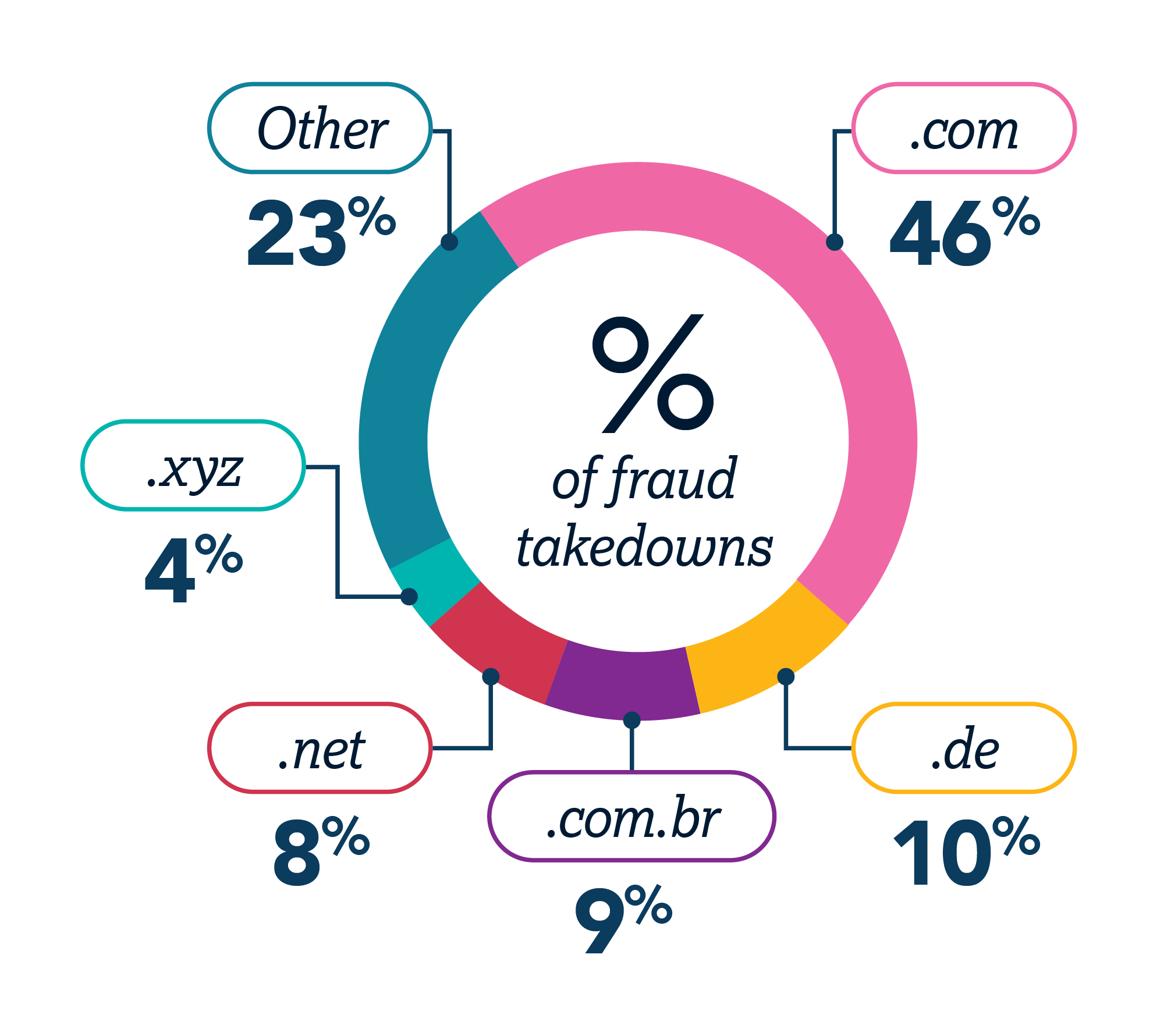
It also found that 75% of the top extensions used in fraud are generic top-level domains (gTLDs). This matters because .com, .net, .org, .biz, and .info are long-established, globally recognized, and open to broad registration. Their legitimacy with consumers makes them useful for corporate brands—but also attractive to threat actors. A phishing domain that appears to use a credible extension can increase the likelihood that a user clicks, logs in, or shares sensitive information.
The report also highlights the rise of “quasi-gTLDs”—country-code domains that are commonly marketed and used like generic extensions. Examples include:
- .tv, Tuvalu’s country-code domain, often associated with television and media
- .co, Colombia’s country-code domain, frequently treated as a typo-adjacent alternative to .com
- .cc, the Cocos Islands’ domain, marketed as an alternative to .com
For security leaders, this creates a strategic gap, where the domains companies register for legitimate brand protection don’t always align with the extensions most used in fraud.
Why fraudsters target specific top-level domains
Fraudsters favor domains that are easy to register, inexpensive to acquire, difficult for consumers to distinguish from legitimate domains, and capable of supporting fast-moving phishing attacks. Unrestricted gTLDs—such as .com and .net—meet many of those criteria.
The same logic applies to many new or repurposed extensions. CSC’s report shows that corporations often register new gTLDs in categories that include generic terms useful in phishing attacks—such as .cloud, .app, and .shop—because these domains can appear legitimate when used for hosting a fraudulent website.
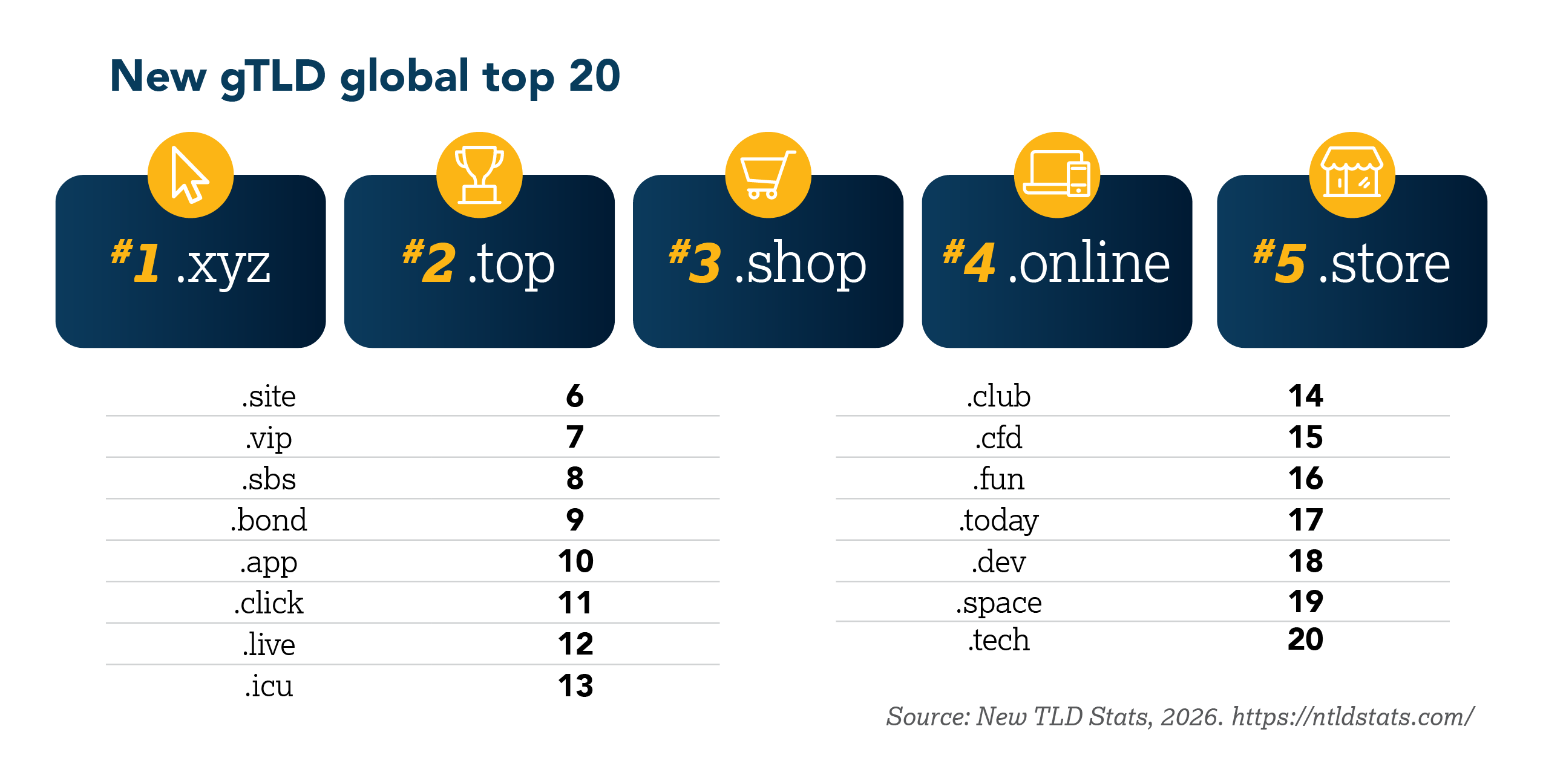
Quasi-gTLDs add another layer of complexity. While technically country-code domains, extensions like .tv and .cc are often used beyond their original geographic purpose. For example, .cc has been marketed and operated like a gTLD for more than 20 years as an alternative to .com.
For CISOs, legal teams, and brand protection leaders, the challenge is scale. Monitoring only core brand domains isn’t enough. Organizations must account for misspellings, lookalike domains, market-specific extensions, campaign-related domains, and high-risk top-level domains (TLDs) where fraudsters are most active.
The consequences of inaction on brand reputation
When fraudulent domains go unmonitored, the consequences can escalate quickly from technical risk to business risk. A spoofed website can erode client trust, expose customers to phishing attacks, divert revenue, and trigger legal, compliance, or regulatory concerns. Even when the organization isn’t directly responsible for the fraudulent site, customers still associate the experience with the brand.
CSC’s report identifies a potential gap between where companies register domains and where fraudulent activity occurs, noting that some extensions used in fraud are not commonly registered by large corporations. Organizations must factor these gaps into domain strategy.
This becomes a return-on-risk question for financial and strategic leaders. Defensive domain registrations, monitoring, enforcement, and fraud protection services require investment, because the cost of inaction can grow far greater to include lost revenue, reputational damage, customer remediation, and executive scrutiny.
Strategic steps to protect your domain portfolio
A stronger domain strategy begins with visibility. Organizations should conduct regular audits of their corporate domain registrations to identify coverage gaps, redundant assets, expired domains, unmanaged domain name system (DNS) records, and high-risk extensions that may warrant defensive registration.
CSC recommends considering current trademarks, priority markets, higher-risk domain extensions, and alternative domain variations when shaping a portfolio. The report also notes that registering every possible extension and variation is typically cost prohibitive, so organizations should balance protection with cost efficiency.
Technology and monitoring are equally important. CSC’s DomainSecSM platform can help organizations identify cybersecurity oversights, secure online digital assets, and protect brand reputation from cyber threat vectors. CSC also provides online brand protection, combining monitoring and enforcement, along with fraud protection services designed to combat phishing in the early stages of attack.
Secure your digital footprint today
Fraudulent domains will continue to evolve as attackers target predictable consumer behavior patterns, emerging extensions, and gaps in corporate registration strategies. To mitigate cyber threats, organizations need continuous threat surveillance, proactive governance, and a domain portfolio that reflects where fraud is happening—not just where the business already operates.
Partnering with a trusted provider can help organizations protect brand reputation and build long-term digital resilience.
Download the full Domain Name Trends 2026 report to learn more about registration patterns shaping global domain name strategy and brand protection.